
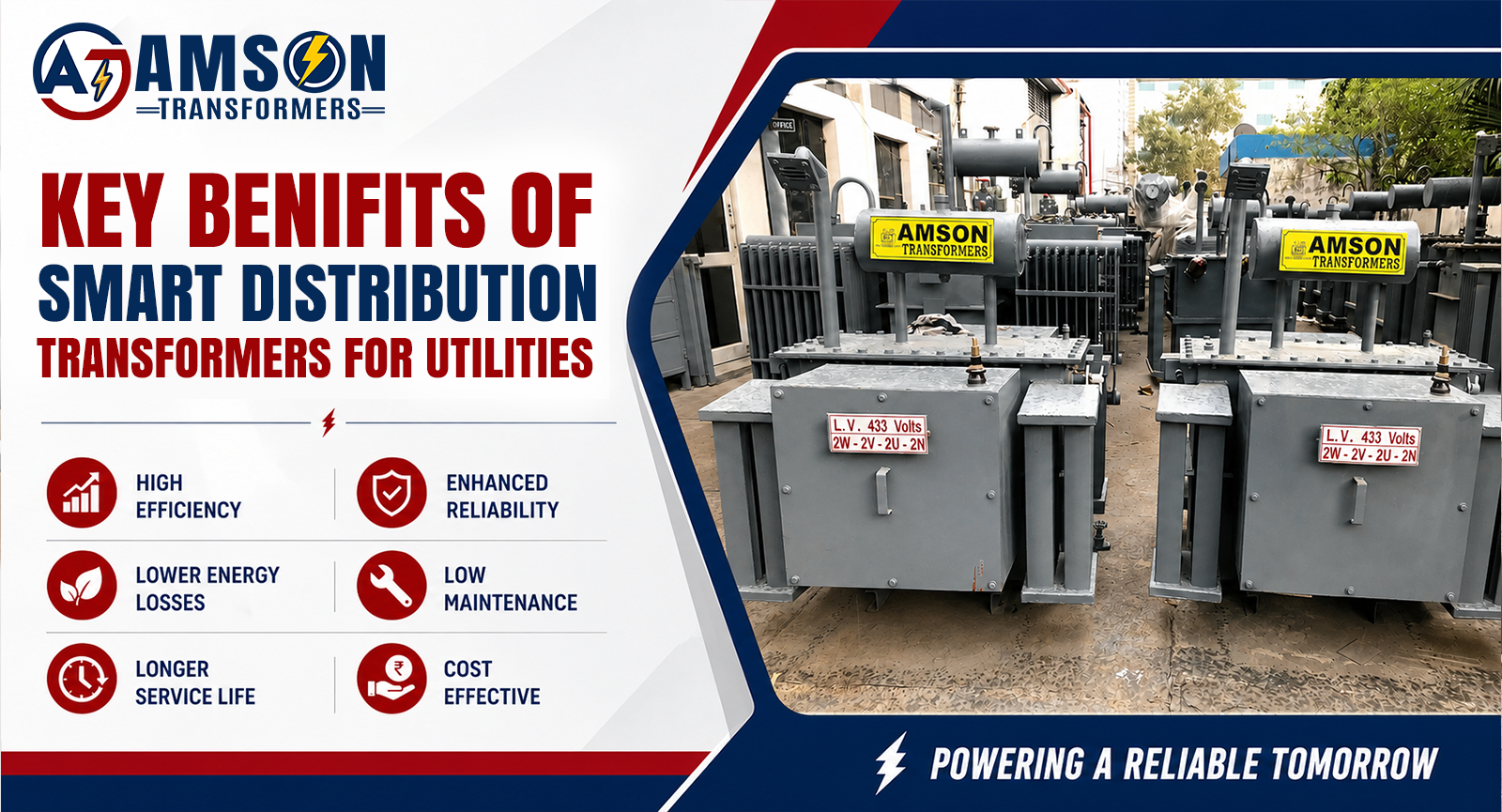
Most people have no idea what a distribution transformer looks like. And that is completely fine; it is not the kind of equipment that demands attention. It’s placed on a pole outside your neighbourhood or inside a small substation near your office building, and it does its work without creating any problem. The lights stay on, and the machines keep running.
But here is the thing: for a utility company responsible for keeping thousands of these transformers working across an entire city or region, a conventional transformer is actually a problem. It gives you nothing. No data, no health updates, no warning when something is starting to go wrong. The first sign of trouble is usually the failure itself, and by that point, the damage is already done.
Smart distribution transformers work differently. They do everything a regular transformer does. They report their own condition, flag issues early, and give utility teams the kind of information that makes network management manageable.
How a Distribution Transformer Works?
High-voltage electricity cannot go directly into your home or factory. The voltage levels used for long-distance transmission, 11kV, 33kV, and sometimes much higher, would destroy any normal appliance or machine instantly. Something has to bring those voltages down to a safe, usable level before electricity can reach the end consumer. That is exactly what this transformer does.
The working of the distribution transformers is rooted in a principle called electromagnetic induction. Two copper coils, one primary, one secondary, are wound around a steel core. When electricity flows through the primary coil, it creates a magnetic field in the core. That magnetic field then generates a voltage in the secondary coil. By changing how many times each coil is wound around the core, you control how much the voltage changes.
In distribution networks, that change is always a step down. 11kV or 33kV coming in from the grid becomes 415V or 230V going out to consumers. Our transformer steps voltage down with accuracy, delivering efficient, reliable energy for industrial, commercial, and residential needs, keeping your world powered smoothly and safely.
What Does “Smart” Mean?
It means the transformer has sensors, metering hardware, and a communication system built into it.
Those sensors measure things like current, voltage, winding temperature, and oil temperature, not once a week during an inspection, but continuously, every minute of every day. The metering modules track energy consumption, power quality, and load levels. And all of that data gets sent through GPRS, fiber, RF, or PLC to the utility’s main control system, where operators can inspect it regularly.
Think about what that changes. Instead of a transformer that could be overheating for weeks with no one knowing, you have one that flags the issue the moment temperatures start climbing past normal levels. Instead of discovering a fault after an outage, you get an alert while there is still time to do something about it.
That shift, from reactive to proactive, is the core of what smart distribution transformers bring to utility operations.
Where Are These Transformers Used?
These transformers are used across different sectors because they are capable of efficiently managing the power supply. Different areas where these transformers are used are:
- Fleet Modernisation, AT&C Loss Reduction, SCADA Integration, State Electricity Boards, and DISCOMs
- Industrial Facilities, because they are Reliable, quality power for your manufacturing and processing operations
- Hospitals, as they supply chain resilience where any disruption has a direct impact on patient safety
- Telecom networks, because of reliable power for geographically dispersed infrastructure
- Railways, for an accurate, reliable supply with remote network monitoring
- Smart city projects transform data into wider urban management platforms
- Renewable Energy Zones, because of voltage Management and Bi-directional Flow for High-Density Solar Areas
The common thread across all of these is simple: operations that cannot afford to guess what their power infrastructure is doing. Smart distribution transformers give them the visibility and control to stop guessing.
Distribution Transformer Key Advantages
Switching to a smart transformer isn’t just a technical upgrade; it’s a decision that saves money, prevents failures, and makes your entire network easier to manage. The advantages of this transformer are as follows:
- Real-time visibility into transformer health across the fleet
- Early fault detection that avoids outages, reduces emergency repair costs
- Live load management to improve network stability and inform capital planning
- Improved efficiency and monitoring to reduce AT&C losses measurably
- Fully compatible with rooftop solar and distributed energy sources
- Maintenance based on real condition data for longer asset life
These advantages don’t work in isolation; together, they add up to a network that’s more reliable, more efficient, and far less stressful to run.
Conclusion
The case for smart distribution transformers is simple. Fewer failures, lower losses, and better control over a grid that is getting more complex every year. And equipment that actually tells you what it needs before breaking down. For utilities still managing transformer fleets the old way, the cost of that approach shows up in emergency repairs, unexplained losses, and outages that could have been avoided. Smarter infrastructure is the practical answer to that problem. Amson Transformers has been building it for over four decades; they are a good place to start that conversation.
FAQ’s
A regular distribution transformer steps the voltage down and does nothing else. A smart transformer does the same thing but also continuously monitors its own performance, measuring load, voltage, temperature, and power quality, and sends that data to the utility’s control system in real time. That information is what allows utilities to catch problems early, manage loads better, and maintain assets based on actual condition rather than guesswork.
Two ways. Amorphous metal core designs reduce no-load losses by 60 to 70 percent compared to standard CRGO core transformers, that saving runs continuously, every hour of every day. Real-time monitoring identifies operating conditions that quietly drive excess losses, low power factor, harmonic distortion, and sustained overloading, so they can actually be addressed rather than running undetected for months.
It depends on what infrastructure is already in place. GPRS or GSM works well for areas with cellular coverage. RF mesh suits wide AMI network deployments. Power Line Communication uses the existing LT network itself as the data channel. Fiber-optic connections work for high-bandwidth SCADA setups. Most utilities use a combination depending on geography and existing systems.
The main savings come from three places: avoided costs from unplanned failures, which run from ₹5 lakh to ₹50 lakh per incident; reduction in AT&C losses through better efficiency and monitoring; and longer transformer life from condition-based maintenance. Utilities with larger fleets and higher baseline losses have the strongest financial case, and payback data from existing deployments clearly support the investment.