
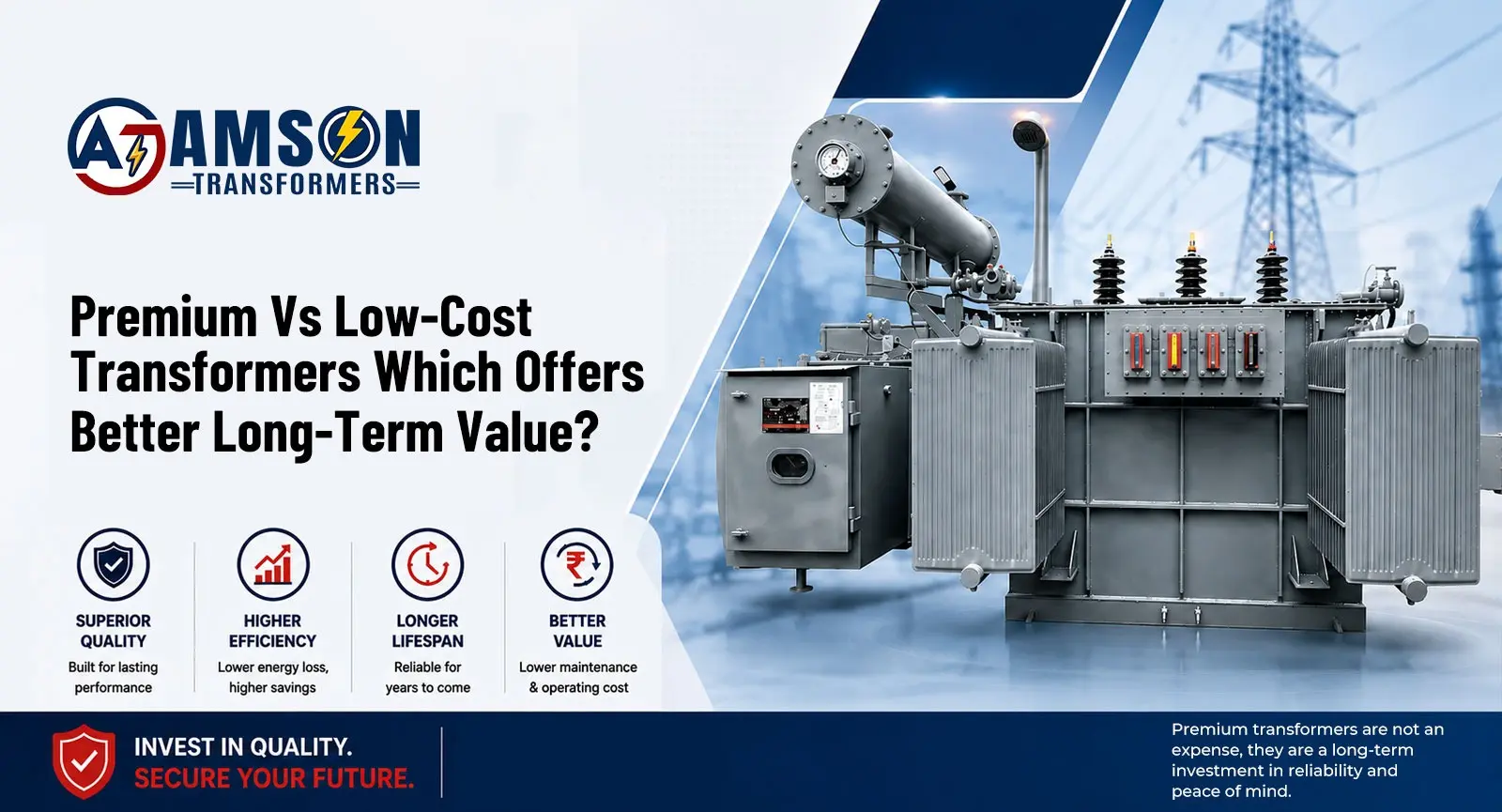
Quick Summary: Two industrial transformers can carry the same rating and sit at wildly different price points, and it’s tempting to assume the gap is just markup. It usually isn’t. This guide looks at what’s driving that price difference, where it matters most, and how to figure out which option genuinely fits your operation instead of just your budget.
Introduction
Ask any procurement team what catches their eye first when comparing transformers, and it’s almost always the purchase price. A low-cost option will definitely be the one most people will go with, especially when budgets are already stretched thin. But transformers aren’t something you buy once and forget about; they’re expected to run continuously for twenty, sometimes thirty years. Stretched across that kind of timeline, energy losses, maintenance needs, and the cost of unreliability tend to add up to far more than whatever gap existed in the original price tag.
This article steps past the sticker price and looks at what decides long-term value, efficiency, losses, total cost of ownership, and how a transformer performs under operating conditions day after day. The goal is simple: help engineers, plant managers, and buyers figure out when spending more on a premium transformer genuinely pays off, and when a lower-cost option is a perfectly reasonable call.
The Cost Driver: Transformer Losses and Efficiency
When it comes to transformer efficiency, two things matter: no-load losses and load losses. Both add to your running costs, so it is important to carefully analyse both these things before buying one.
No-Load Losses (Core Losses)
No-load losses happen the moment a transformer is switched on, whether or not anything’s drawing power from it. How much of this loss you get mostly comes down to the quality of the core material, the design, and how precisely it was manufactured.
A few things worth knowing about it:
- It’s running constantly, 24/7, for as long as the transformer stays energized; there’s no way around it once the unit is on.
- It matters more for transformers that are lightly loaded or left energized continuously, since the loss doesn’t scale down with a smaller load.
- Better core steel, or something like an amorphous metal core, brings this number down noticeably.
For any facility running transformers around the clock, lower no-load losses translate into savings that keep adding up, year after year, without much extra effort.
Load Losses (Copper Losses)
Load losses work a bit differently — they grow much faster as the load current goes up, since the loss increases with the square of that current. That’s why winding resistance and the overall design of the transformer play such a big role here.
A few points that matter here:
- These losses become the bigger factor once a transformer is running near full load.
- What drives them is the conductor material, copper versus aluminum, along with the cross-section size and operating temperature.
- Lower load losses mean less heat buildup, better overall efficiency, and usually a longer life for the insulation too.
High-load environments, manufacturing plants, data centers- that kind of continuous heavy use- see the biggest payoff from transformers built with load losses specifically optimized.
Total Cost of Ownership (TCO): The Decision Framework That Matters
Total Cost of Ownership (TCO) brings all cost elements into one comparison:
TCO = Purchase Price + Capitalized Cost of No-Load Losses + Capitalized Cost of Load Losses + Maintenance & Downtime Costs
A simplified version often used in evaluations:
TEC (Total Evaluated Cost) = Purchase Price + (A × P₀) + (B × Pₖ)
Where:
- P₀ = no-load losses (W)
- Pₖ = load losses (W)
- A, B = capitalized loss factors based on electricity cost, evaluation period, discount rate, and expected load profile
When you run this calculation, the transformer with the lowest TEC is usually the best long-term value, even if its purchase price is higher. Studies show that premium-efficiency transformers often have payback periods of 4–8 years, after which they continue saving money for the remainder of their 25–30-year life.
Where Premium Transformers Are Useful
There are a handful of situations where paying more for a premium transformer is useful; these conditions are:
- When the load factor is high. If a facility is running near full capacity most of the time, lower load losses start making a difference to the bottom line.
- When the transformer is energized around the clock. Plants running 24/7 get more value out of reduced no-load losses, simply because that loss never stops accumulating either.
- When downtime is expensive. For critical applications where an outage costs money, the better build quality and reliability of a premium unit lowers that risk meaningfully.
- When the transformer’s expected to last 20+ years. Over that kind of stretch, even small efficiency gains compound into a substantial amount of savings.
In any of these situations, the extra money spent upfront tends to come back many times over across the transformer’s working life.
When Low-Cost Transformers Are Used
Choosing a low-cost transformer isn’t automatically a bad call. In the right situation, it’s the smarter one. These transformers are used when:
- When the load is light and only runs occasionally. If a transformer isn’t working hard for long stretches, the savings from a premium unit’s lower losses might never catch up to what you paid extra for it.
- When the project is short-term. Temporary setups, or sites only expected to run for five to seven years, often won’t stick around long enough to see the full payback a premium transformer would eventually offer.
- When budget is tight, and there’s a plan to upgrade later. If capital is limited right now but there’s a clear path to replace or improve the setup down the line, a lower-cost option can bridge that gap reasonably well.
- When the load isn’t critical. If a bit of downtime or slightly lower efficiency wouldn’t disrupt operations, there’s less reason to pay for reliability you don’t need.
The point here is to choose purpose. Go with the lower-cost option because the numbers support it for your situation, not just because it’s the cheaper number on the quote.
Conclusion
At the end of the day, the better transformer isn’t the cheaper one or the pricier one; it’s whichever one matches how hard your operation is going to run it. Heavy, continuous loads usually justify paying more upfront. Light, occasional use often doesn’t need to. Amson Transformers builds both options with that same thinking in mind, so what you’re buying isn’t just a transformer; it’s years of dependable performance suited to your actual load.
FAQs
Everyone talks about total cost of ownership for transformers; how do I calculate it myself?
At its core, you’re adding up the purchase price plus the cost of every watt of loss over the transformer’s expected lifespan, using your own electricity tariff and load profile. Manufacturers can usually help run these numbers if you give them your actual operating conditions rather than relying on generic estimates.
If two transformers have the same efficiency rating, does it even matter which one I pick?
It can, more than people expect. Efficiency ratings are often tested under standard conditions that don’t always reflect how a transformer performs at your specific load level, so it’s worth asking how the unit behaves at your typical operating point, not just at the rating shown on paper.
Is it true that a transformer running at 40% load wastes more energy than one running near full capacity?
Not exactly wastes more, but it can lose relative efficiency, since no-load losses stay constant regardless of how much the transformer is working. A lightly loaded transformer ends up “paying” that fixed loss proportionally more, which is part of why sizing correctly matters as much as picking premium versus budget.
How do I know if a supplier's test reports are legitimate and not just marketing numbers?
Ask for certified third-party test reports rather than manufacturer-provided figures alone, and check that the losses are reported under standard test conditions you can compare across quotes.
Does buying premium always mean buying from the most expensive brand on the list?
Not necessarily; premium here refers to the unit’s build quality, materials, and efficiency, not the brand name slapped onto it. To judge value, actual loss figures and TCO comparisons between manufacturers are more reliable than assuming that price alone reflects quality.